

The Cliché That Proves the Point
"The walls come down" is everywhere in worship music right now. Here's the irony nobody mentions: Jericho is the least repeatable story in the entire Bible. We took the one battle God designed to never happen again and turned it into a formula.
The Phrase You’ve Heard a Hundred Times This Year
If you’ve had Christian radio on at all this year, you’ve heard it.
The walls come down. The walls are falling. Just like Jericho.
It’s the current cliché. And there’s always a current cliché. A few years back everything was breaking every chain. Before that it was fire — fire fall down, set a fire, holy fire. Before that, oceans, and shaky ground, and I’m no longer a slave to fear. These phrases sweep through worship music in waves. One songwriter lands on an image that works, and within eighteen months it’s on forty other tracks.
This isn’t a knock on worship music. Songwriters borrow from each other the way preachers borrow illustrations. And most of these phrases come straight out of Scripture, which is exactly where they should come from.
But the Jericho one is worth stopping on. Because of all the clichés we’ve reached for, this is the one that, if you actually read the story it comes from, says the opposite of what we use it to say.
We use “the walls come down” to mean: keep praising, keep pushing, keep believing, and eventually the obstacle in your life will collapse. It’s become a formula for breakthrough. A recipe. Do the Jericho thing and you’ll get the Jericho result.
But Jericho is the single least repeatable battle in the Bible.
That’s not an exaggeration. It’s the whole point of the story.
Read the Actual Instructions
Go back and read what God actually told Joshua to do. Don’t read it as a worship lyric. Read it as a battle plan handed to a general.
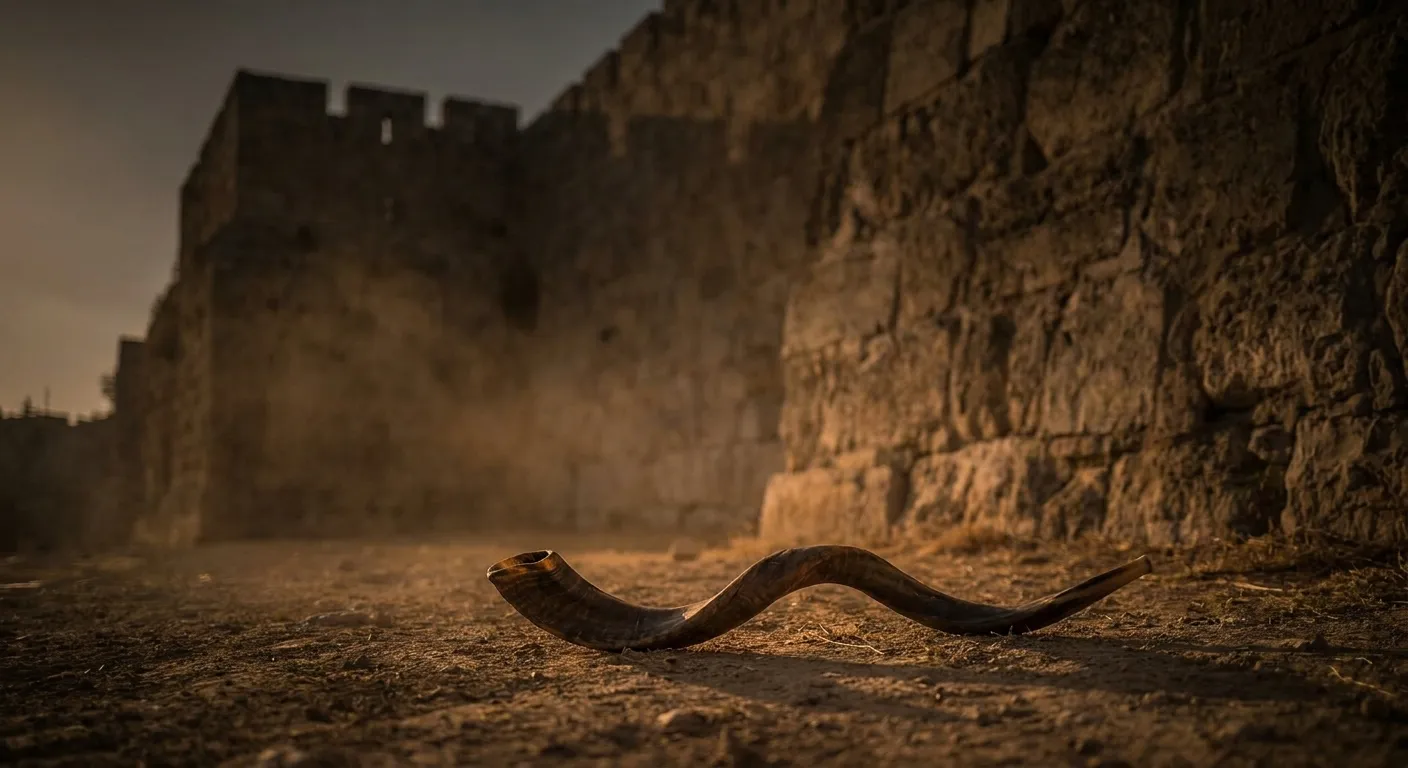
Yahweh said to Joshua, “Behold, I have given Jericho into your hand, with its king and the mighty men of valor. All of your men of war shall march around the city, going around the city once. You shall do this six days. Seven priests shall bear seven trumpets of rams’ horns before the ark. On the seventh day, you shall march around the city seven times, and the priests shall blow the trumpets. It shall be that when they make a long blast with the ram’s horn, and when you hear the sound of the trumpet, all the people shall shout with a great shout; then the city wall will fall down flat, and the people shall go up, every man straight in front of him.”
March around the city once a day for six days. Bring the priests. Bring the ark. Have seven priests carry seven trumpets. On the seventh day, march around seven times. Then have the priests blow the trumpets, have the people shout, and the wall will fall down flat.
Now imagine you’re a military commander and your superior hands you that plan.
There is no military logic in it anywhere. Marching in a circle does not weaken a stone wall. Trumpets are not a siege weapon. Shouting is not tactics. If you ran this plan past any general in human history, before or since, they would tell you it is not a plan at all. It’s a religious procession that happens to be pointed at a fortified city.
And that is precisely why it’s in the Bible.
The Jericho instructions were not a strategy. They were an act of listening. The whole design of the thing — the seven days, the seven priests, the seven trumpets, the seven laps, the silence until the shout — was built so that when the wall came down, nobody on earth could mistake it for something Israel did. There was no technique to credit. There was only a God who spoke and a people who did exactly, precisely, strangely what He said.
Jericho wasn’t a recipe. It was a one-time set of instructions, custom-built for one city, on one day, that worked for one reason: God said so.
And Then Look at the Very Next Battle
Here’s the part that should end the “Jericho formula” idea for good.
The very next city Israel fought was Ai. Right next door. Next chapter. And if Jericho had established a formula — march, trumpets, shout — then Ai is where you’d run it again.
God doesn’t run it again. He doesn’t even come close.
Yahweh said to Joshua, “Don’t be afraid, and don’t be dismayed. Take all the warriors with you, and arise, go up to Ai. Behold, I have given into your hand the king of Ai, with his people, his city, and his land. You shall do to Ai and her king as you did to Jericho and her king, except you shall take its goods and its livestock for yourselves. Set an ambush for the city behind it.”
Set an ambush behind the city.
That’s it. That’s the plan for Ai. No march. No trumpets. No priests. No ark out front. No seven of anything. This time it’s military deception — lure the defenders out with a fake retreat, then spring a hidden force behind them and take the empty city.
Two cities. Back to back. Same army, same commander, same God. And the instructions have nothing in common.
If you were standing next to Joshua after Jericho, holding a notebook, writing down The Jericho Method™ — march, trumpets, shout — you would have filled a page with a recipe that God Himself was about to throw out one chapter later.
It Keeps Happening
And it’s not just those two. Once you see the pattern, you see it everywhere in the Old Testament.
Gideon has an army of thirty-two thousand men, and God reduces it. Not adds to it — reduces it. Down to three hundred.
Yahweh said to Gideon, “I will save you by the three hundred men who lapped, and deliver the Midianites into your hand. Let all the other people go, each to his own place.”
And then the weapons He hands those three hundred men are not weapons. They’re trumpets, clay jars, and torches. The battle plan is: surround the camp in the dark, smash the jars, blow the trumpets, hold up the torches, and shout. The enemy panics and destroys itself. It is nothing like Jericho. It is nothing like Ai. It is its own strange, specific, one-time thing.
Jehoshaphat is surrounded by three armies and has no idea what to do, so he inquires of the Lord — and God’s instructions are maybe the strangest of all. Don’t send the soldiers first. Send the worship team.
When he had taken counsel with the people, he appointed those who were to sing to Yahweh and give praise in holy array as they go out before the army, and say, “Give thanks to Yahweh, for his loving kindness endures forever.”
Singers. Out in front of the army. Praising God for the victory before a single sword is drawn. And the enemy armies turn on each other while Judah never lifts a weapon.
March and trumpets. Ambush. Torches and jars. The choir goes first.
Four battles. Four completely different methods. Zero repeats.
That is not an accident in the text. That is the text telling you something.
What the Pattern Is Actually Saying
Here’s what I think God is doing across all of these stories, and it matters for the next five parts of this series.
If God had a formula — if there were a reliable, repeatable technique that produced spiritual breakthrough — then His people would learn the technique and stop needing Him. They’d have the recipe. You don’t have to stay close to a cook whose recipe you’ve already memorized. You can take the recipe home and never see the cook again.
So God doesn’t give a recipe. He gives instructions. And the instructions change every single time, which means His people can never graduate from asking. They can never get to a place where they have the method and no longer need the relationship. Every new battle sends them back to the same place: on their knees, asking, what do You want us to do this time?
The variety isn’t God being unpredictable for the fun of it. The variety is God protecting the relationship. He refuses to be reduced to a process, because the moment He becomes a process, people stop coming to the Person.
We took the one story in Scripture most designed to make that point — Jericho, the battle with no technique, the battle that only worked because God said so — and we turned it into a technique.
That’s the irony this whole series is built on. And it’s worth sitting with, because the same instinct that turned Jericho into a worship cliché is the instinct that quietly runs a lot of our spiritual lives. We are always, always looking for the recipe.
The Old Testament keeps telling us there isn’t one.
Why This Matters For You
You might be reading this thinking, fine, but I’m not fighting the Philistines. What does this have to do with my Tuesday?
Here’s the connection.
You have a Jericho in your life right now. A wall. A marriage that won’t soften. A child who won’t come home. A habit you can’t break. A career that won’t open. A diagnosis. A grief. A door that has stayed shut for years.
And the instinct — the deep, human, understandable instinct — is to look for the recipe. What’s the formula? What’s the prayer I haven’t prayed, the book I haven’t read, the technique I haven’t tried, the spiritual move that finally makes the wall come down?
This series is going to gently take that question apart. Not because seeking breakthrough is wrong — it isn’t — but because the recipe you’re looking for doesn’t exist, and the looking itself is keeping you from the thing that actually works.
The thing that actually works is not a method. It’s the same thing it was for Joshua, for Gideon, for Jehoshaphat, for David. It’s getting close enough to God to ask — and then doing exactly what He says, even when what He says this time looks nothing like what He said last time.
The walls did come down at Jericho. That part of the song is true.
But the God who brought them down had a thousand other ways to win — and He has never, not once, used the same one twice.
A Prayer
Father, I have been looking for the recipe. I didn’t always call it that, but that’s what it was. I’ve wanted the technique, the formula, the reliable spiritual move that produces the result I’m after.
Forgive me for wanting Your power more than I want You.
Thank You that You refuse to be reduced to a process. Thank You that every story in Scripture sends Your people back to the same place — on their knees, asking. Thank You that You designed it that way on purpose, because You wanted to be needed, not just used.
Teach me, over these next few weeks, to stop hunting for the recipe and start learning to ask. Show me the wall in my life that I’ve been trying to formula my way through. And make me willing to do whatever You actually say — even if it looks nothing like what worked for someone else, or what worked for me last time.
I want to stay close to the Cook, not just walk off with the recipe.
Amen.
Reflection Questions
-
What’s the “Jericho” in your life right now — the wall you’ve been trying to bring down? Be specific. Name it.
-
What recipe have you been running at it? A prayer formula, a spiritual technique, a “if I just do enough of X” approach? Where did you get the idea that it should work?
-
Read Joshua 6 and Joshua 8 back to back. Sit with how completely different the two battle plans are. What does it tell you that God refused to reuse Jericho’s method even on the very next city?
-
Be honest about the instinct. Why do you think you (and most of us) reach for a formula instead of asking? We’ll dig into that in Part 4 — but start noticing it now.
Coming Up Next
If God never reused a battle plan for an entire nation, what happens when one person assumes the old plan still works? In Part 2, we’ll look at David and the Philistines — the same enemy, in the same valley, attacking twice in a row. David could have just run the play that worked six verses earlier. What he did instead is the whole reason he won.
Next: “Same Enemy, New Orders” — The Battle David Almost Fought the Wrong Way